The Ultimate Guide to Bottle Screen Printing Machines: Elevate Your Packaging in 2026
Master Your Brand: The Ultimate Guide to Bottle Screen Printing Machines
In a competitive market, your product's packaging is its first handshake with the customer. While a great label has its place, direct screen printing on plastic and glass bottles offers a premium, durable, and seamless look that can elevate a brand from ordinary to exceptional. But how is it done? The magic lies in a specialized piece of equipment: the bottle screen printing machine.
This guide will walk you through everything you need to know about these versatile machines, helping you understand the technology that can transform your bottling and packaging operations.
What Exactly is Bottle Screen Printing?
Bottle screen printing is a decorating process where ink is applied directly to a bottle's surface through a mesh screen. A stencil of the desired design is created on the screen, blocking parts of the mesh. The bottle is placed on the machine, and a squeegee pushes ink through the open areas of the stencil onto the bottle's surface. The bottle rotates in perfect sync with the screen's movement, allowing for a smooth, continuous print around cylindrical or conical shapes. This method is renowned for creating vibrant, opaque, and incredibly durable designs that bond directly with the container.
Why Choose Screen Printing for Plastic Bottles?
Before investing in a machine, it's crucial to understand the benefits. Compared to traditional paper or plastic labels, direct screen printing offers compelling advantages:
- Unmatched Durability: Screen-printed designs are highly resistant to moisture, chemicals, scratching, and fading. This is ideal for products used in wet environments like kitchens and bathrooms (e.g., shampoos, cleaning supplies) or those that experience frequent handling.
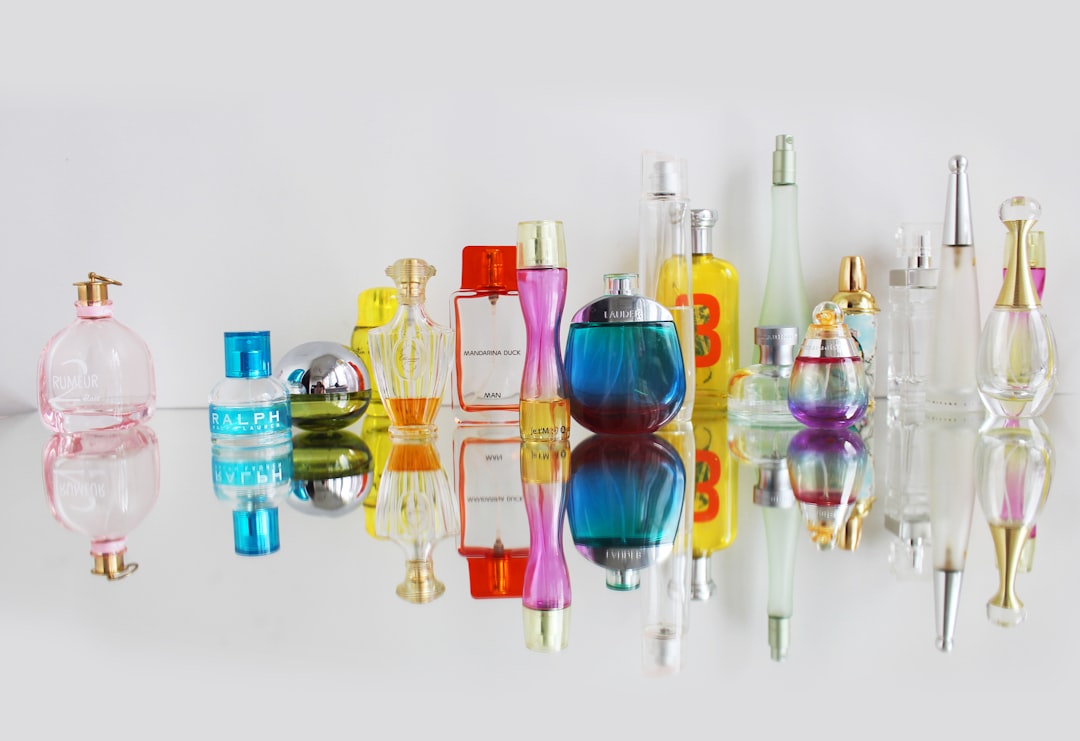
- Premium Aesthetic Appeal: Printing directly on the bottle creates a sleek, no-label look that consumers often associate with higher quality. It allows the bottle's own color and texture to be part of the design, leading to a more integrated and sophisticated brand presentation.
- Enhanced Branding Real Estate: Screen printing can cover a larger surface area of the bottle, often up to a near 360-degree wrap. This gives designers more freedom and space to tell a brand's story without the constraints of a standard label size.
- Cost-Efficiency at Scale: While initial setup has costs, the process can be highly cost-effective for medium to large production runs, eliminating the need for separate label inventory, application machinery, and the labor associated with them.
The Heart of the Operation: Components of a Bottle Screen Printer
A bottle screen printing machine, whether simple or complex, shares a few core components:
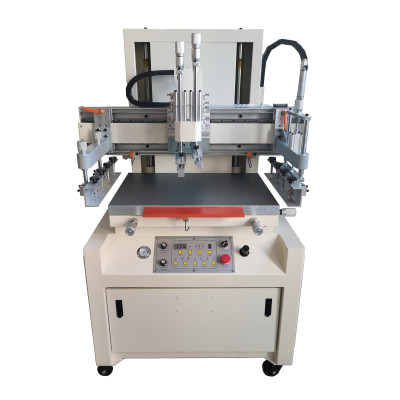
- The Frame and Screen: A polyester mesh screen is stretched tightly over a metal frame. This screen holds the emulsified stencil of your design.
- The Squeegee: A rubber or polyurethane blade that pushes ink across the screen and through the stencil.
- The Bottle Fixture/Jig: This is a crucial part that holds the bottle securely in place. For round bottles, this often involves rollers that allow the bottle to rotate smoothly during printing. For irregular shapes, custom jigs are required.
- Registration System: In multi-color printing, this system ensures that each color is applied in the exact correct position relative to the others, guaranteeing a sharp, aligned final image.
- Curing Unit: After printing, the ink must be cured to become permanent. This is usually a UV lamp or a heat tunnel integrated into the machine or as a separate station.
Types of Bottle Screen Printing Machines
Bottle screen printing machines fall into three main categories, defined by their level of automation, speed, and cost.
| Machine Type | Speed | Cost | Best For |
|---|---|---|---|
| Manual | Low (50-200 pieces/hr) | Low | Startups, small batches, custom/promo items |
| Semi-Automatic | Medium (300-1000 pieces/hr) | Medium | Growing businesses, medium production runs |
| Fully Automatic | High (1500-4000+ pieces/hr) | High | Large-scale manufacturing, high-volume products |
Manual Screen Printers: The Entry Point
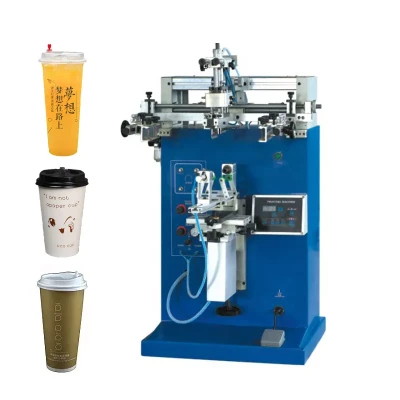
Manual machines are the simplest and most affordable option. The operator is responsible for loading and unloading the bottle, lowering the screen, and manually pulling the squeegee to make the print. These are excellent for small businesses, promotional product companies, or for prototyping designs before committing to a larger run.
Semi-Automatic Machines: The Best of Both Worlds
Semi-automatic machines offer a significant step up in efficiency. In this setup, the operator places the bottle onto the fixture, but the printing and squeegee motion are automated, triggered by a foot pedal or buttons. This ensures greater consistency in print quality and speed compared to manual methods. They represent a sweet spot for businesses experiencing growth but not yet ready for a full-scale industrial line.
Fully Automatic Systems: For High-Volume Production
Fully automatic machines are the pinnacle of bottle printing technology. These systems feature automated bottle loading from a hopper or conveyor, surface pre-treatment (like flame treatment), multi-color printing stations, and integrated UV curing, all in one continuous process. Operator involvement is minimal, making them perfect for large-scale manufacturing where speed, consistency, and efficiency are paramount. These machines can print thousands of bottles per hour.
The Importance of Pre-Treatment: Making Ink Stick
Plastic, especially materials like HDPE and PP, has a low surface energy, which means ink won't adhere to it properly without help. This is why pre-treatment is a critical step. The two most common methods are:
- Flame Treatment: The bottle briefly passes through a controlled flame, which oxidizes the surface and increases its dyne level, making it receptive to ink.
- Corona Treatment: An electrical discharge creates a high-energy corona that alters the surface tension of the plastic, achieving a similar effect to flaming.
Many automatic and semi-automatic machines have built-in pre-treatment stations to streamline this essential step.
Choosing the Right Ink for Plastic Bottles
The most advanced machine is useless without the right ink. For plastic bottles, the dominant choice is UV-curable ink.
UV-Curable Inks are liquid inks that dry—or more accurately, cure—almost instantly when exposed to intense ultraviolet (UV) light. Their advantages are numerous:
- Speed: Instant curing allows for faster production speeds and immediate handling.
- Durability: They form a hard, resilient finish that is highly resistant to scratches and chemicals.
- Vibrancy: UV inks are known for their bright, high-gloss finish.
- Environmental: They contain low to zero volatile organic compounds (VOCs) compared to traditional solvent-based inks.
Other options like Solvent-Based Inks are also available and known for their toughness, but require proper ventilation and have longer drying times unless paired with heat tunnels.
The Curing Process: Locking in the Design
Curing is the final, non-negotiable step that ensures the print is permanent. For UV inks, this involves passing the freshly printed bottle under a high-intensity UV lamp. The UV energy triggers a chemical reaction (photopolymerization) that transforms the liquid ink into a solid, durable layer in a fraction of a second. This process is fast, energy-efficient, and a key reason why UV screen printing is the go-to method for modern bottle decoration.
Key Factors to Consider Before Buying a Machine
Ready to invest? Here are the critical questions to ask:
- Production Volume: How many bottles do you need to print per hour, day, or month? Be realistic about your current needs and future growth. This is the single biggest factor determining whether you need a manual, semi-, or fully automatic machine.
- Bottle Shape and Size: Will you be printing on simple round bottles, or will you need to handle ovals, squares, or tapered shapes? Cylindrical printers are standard, but irregular shapes require more complex, and often more expensive, machinery with custom jigs.
- Number of Colors: Single-color jobs can be done on simple machines. Multi-color designs require precise registration and either multiple passes on a simple machine or a multi-station automatic printer.
- Material Type: Are you printing on PET, HDPE, PP, or glass? Your machine choice must be compatible with the necessary pre-treatment and ink systems for your material.
- Budget and ROI: Consider the total cost of ownership, including the machine, inks, screens, curing units, and labor. Calculate your return on investment based on reduced labeling costs and increased production efficiency.
Conclusion: A Tool for Brand Distinction
A bottle screen printing machine is more than just a piece of equipment; it's a tool for building a stronger, more memorable brand. By printing directly onto the container, you create a package that is not only durable and functional but also communicates a message of quality and permanence. Whether you're a small craft producer looking to hand-print a few hundred bottles or a multinational corporation churning out millions, there is a screen printing solution that can help your product stand out and leave a lasting impression.