What is curved surface screen printing and what products is it used for?
Curved surface screen printing is a specialized technique that applies ink onto cylindrical, conical, or irregularly shaped objects by rotating the substrate in sync with the squeegee movement. It is widely used for printing on bottles, cups, tubes, pens, cosmetic containers, and other round products where flat printing cannot achieve proper ink transfer.
Detailed Explanation
The curved surface printing process uses a mandrel or fixture that holds the cylindrical product and rotates it as the squeegee draws across the screen. The screen itself moves linearly while the substrate rotates, creating a tangential contact point that transfers ink smoothly around the curve. This synchronized motion ensures even ink deposition and precise multi-color registration.
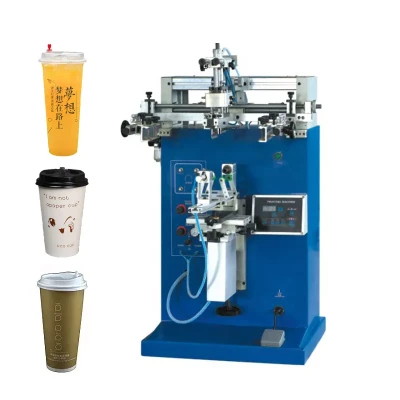
Common products printed with curved surface screen printing include plastic bottles, glass containers, cosmetic tubes, cosmetic jars, cups, mugs, pens, batteries, and LED housings. CooPrinter's curved screen printing machines handle diameters from 10mm to 150mm and lengths up to 300mm, covering most industrial and consumer product requirements.
The China screen printing market, valued at 587.3 billion yuan in 2024, sees strong demand from the packaging sector for curved surface printing. CooPrinter's servo-driven curved printing machines, such as the TX-500SF, combine precision motion control with quick-change tooling to handle different container sizes efficiently. Automatic models achieve 300-500 prints per hour with consistent quality.
Key Points
Rotational Printing
Substrate rotates synchronously with squeegee for even ink transfer on curves.
Wide Application Range
Bottles, cups, tubes, pens, batteries, LED housings, and more.
Precision Registration
Servo-driven machines ensure multi-color alignment on curved surfaces.
Related Questions
- How to choose the right screen printing machine for bottles and cosmetic containers?
- How to print on round containers and cups?
- What are the advantages of servo-driven screen printing machines?
Are you looking for a reliable precision screen printing machine manufacture?
We can quickly provide customers with market analysis, technical support and customized services.